


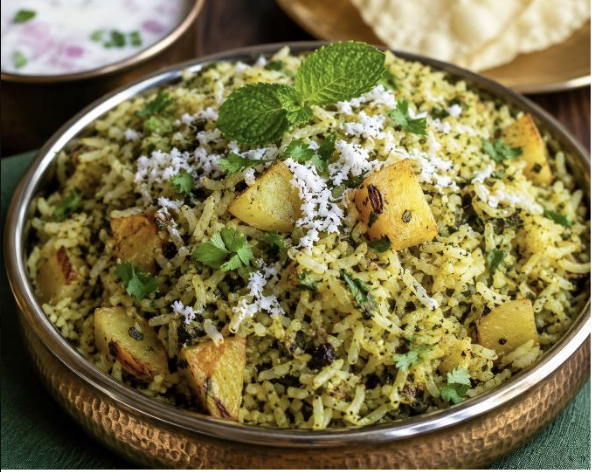
Recipe from Smt. Jaya V. H. Rao (Age 91), shared by her niece, Sharmila Nisudan
There are some recipes that feed a family, and then there are recipes that preserve an entire lifetime of memories.
This Aloo Bath belongs firmly in the second category.
The recipe comes from my mother’s elder sister, Smt. Jaya V. H. Rao, who is now ninety-one years old. A distinguished lawyer, she practised alongside her husband, Sri Vemuganti Harihar Rao, one of Warangal’s respected advocates. Yet, for me, she will always be the warm and affectionate aunt whose home was at the centre of some of my happiest childhood memories.
Many of our summer vacations were spent in Warangal. Those visits were filled with laughter, family gatherings, endless conversations, and of course, unforgettable meals. Even today, when I think of those summers, I can almost smell the aroma drifting out of her kitchen.
More than fifty years later, during a recent visit, she prepared this Aloo Bath once again. Watching her cook it with the same care, precision, and affection was deeply moving. The fragrance of fresh pudina instantly transported me back to those childhood days, as though time had quietly folded in on itself.
What makes this dish special is its simplicity. Rice, potatoes, mint, curd, and spices come together to create something far greater than the sum of its parts. Every bite carries the freshness of mint, the comfort of home cooking, and the warmth of family traditions lovingly preserved across generations.
For me, this recipe is not merely a rice dish. It is a celebration of family, heritage, and the memories that stay with us long after the meal is over.
Aloo Bath (Telangana Style)
Preparation Time: 30 minutes
Cooking Time: 30–35 minutes
Total Time: 60–65 minutes
Serves: 6–8 people
Ingredients
- 500 gm rice (½ kg)
- 500 gm potatoes, peeled and cubed (½ kg)
- 6 green chillies
- 1-inch piece ginger
- 6 cloves
- 4 green cardamoms
- 1 tsp shahi jeera
- 1 tbsp coriander seeds
- 1-inch piece cinnamon
- 2 tbsp grated dry coconut
- 1 pod garlic
- 250 ml sour curd
- 1 bunch fresh mint leaves
- ½ tsp turmeric powder
- Salt, to taste
- 8 tbsp oil
- Approximately 1 litre boiling water (or as required)
For Garnishing
- 2 tbsp chopped fresh coriander leaves
- 2 tbsp freshly grated coconut
Method
Preparation
- Wash and soak the rice for 20 minutes. Drain and set aside.
- Peel and cube the potatoes.
- Deep-fry the potato cubes until golden brown. Remove and keep aside.
Prepare the Masala
- Lightly sauté:
- Green chillies
- Ginger
- Cloves
- Cardamom
- Shahi jeera
- Coriander seeds
- Cinnamon
- Dry coconut
- Garlic
- Mint leaves
- Allow the mixture to cool slightly, then grind it into a smooth paste.
Cooking
- Heat oil in a heavy-bottomed pan over low heat.
- Add the prepared masala paste and sauté for 2–3 minutes until aromatic.
- Add the sour curd and mix well.
- Add the fried potato cubes and cook for about 5 minutes.
- Add the drained rice and gently sauté for 2 minutes.
- Add turmeric powder, salt, and boiling water.
- Cover and cook until the rice is tender and all the water has been absorbed.
- Allow the dish to rest for 5 minutes before gently fluffing with a fork.
To Serve
- Garnish with fresh grated coconut and chopped coriander leaves.
- Serve hot with plain curd, onion raita, papad, or a simple salad.
Notes from the Family Kitchen
Adjust the number of green chillies according to your preferred spice level.
Fresh pudina is the soul of this dish and should not be reduced.
Sour curd gives Aloo Bath its characteristic tangy flavour.
Basmati rice can be used for a more festive version.
Potatoes may be air-fried instead of deep-fried for a lighter preparation.
The flavours deepen beautifully if the dish is allowed to rest for 10–15 minutes before serving.
Traditionally, it is enjoyed during the warmer months, when the cooling qualities of mint and curd are especially welcome.


Leave a Reply